A prioritized, low-cost online pet marketing playbook
When it comes to pet marketing, most small pet brands get stuck between “I don’t have the budget” and “I don’t know where to start.”
If you’re in the same boat, this short playbook is the bridge. I’ve featured clear, low‑cost steps to expand your online presence, so you can start selling more—fast.
Read on for:
✅ Prioritized actions that take you from creation to distribution then conversion to retention.
✅ Tactical tips you can apply to your pet marketing today.
✅ Pet industry marketing examples to get you started.
How can small pet food, pet care, and pet service businesses grow sales on a tight budget?
It doesn’t matter if you’re new to the pet industry or if you’ve been around for decades, figuring out how to sell more pet food, accessories, or grooming appointments without overspending is always on the marketing agenda.
But small businesses face a more immediate problem: with limited budgets and time, what kind of marketing will actually move the needle—now?
Spoiler alert: you’ll want to focus your efforts on building a low-cost, high-ROI online presence. One that turns searchers into buyers and first-timers into repeat customers.
Here’s why online matters today
- 51% of US pet owners typically shop for pet products online.
- 35% of Australian pet owners now purchase pet food and products online.
- 58% of British pet owners shop online.
- 35% of European pet owners shop online, with 58% shopping online at least once a month!
- 46% of pet owners in the Asia-Pacific region shop for pet products online.
These figures show a clear shift.
Shoppers are increasingly researching and buying pet products online, so prioritizing the right digital channels gives small brands the best chance to grow sales on a shoestring.
How to market pet products and services online as a small business
From getting in front of the right audience to converting purchase intent into actual sales, these are the tools and tactics you’ll need to persuade pet parents in today’s market.
1. Build a high‑converting, mobile‑first website for your pet brand
If you want to be taken seriously, then you need to evolve from posting on free platforms like social media (Facebook, Instagram) to investing in an attractive website—even if you’re a Gen Z-oriented pet brand!
I’m sure you already know this but just in case you need that extra little bit of convincing, here’s why you need a website to market your pet business.
✨ It professionalizes your brand and improves your credibility
As you grow, you’ll inevitably want to build your network of business partners and contacts. You may even want to reach new markets. A website shows that you’re committed to your brand, that you take your clients (and business) seriously, and that you’re in it for the long haul. That’s something being a “social-only” business simply can’t do for you.
✨ A website boosts your online presence
A website makes you accessible to people anywhere, anytime; to different customer groups and markets. And with well-thought-out content, your brand can be discoverable for all the right search terms at all stages of a customer’s purchase journey.
✨ Websites are convenient
A website is inclusive: it’s easy to find, use, and access. You can serve anyone—not just those with a social media account! That’s important because not all shoppers have, are comfortable with, or know how to “do business” on social networking sites.
✨ It’s great for branding
Everything from design (layout, colors, fonts, images) to brand voice, writing style and even the type of content you feature is exactly what you want and as you want it. You have total control!
✨ A website multitasks
A website performs multiple functions. It acts as your product showroom, customer service hub, online store, help desk with customer-oriented resources, the latest news and information and so much more—even while you sleep.
✨ Customer data belongs to you
There’s a wealth of information web analytics will give you about the visitors to your site. You can use all that to get to know your audience better and, of course, improve your marketing efforts. Furthermore, the customer data collected via your website, for example through web inquiries or online purchases, belong to your company and not the platform you’re using. (Reminder: always handle personal information collection with the utmost care. Read more aboutGDPR guidelines to be compliant.)
Start here: a quick checklist for your first website
Here’s what to do first plus the website priorities to keep top of mind.
✅ Build a mobile-friendly home page
It should have a clear one-line value proposition, hero image of your product (or similar), and a single call to action (buy, book, subscribe). Check out Canva, Squarespace, Wix, Unbounce, and Shopify for beginner-friendly drag-and-drop options.
✅ Add a product/service/offer section
Focus on one product/service/offer per block with a one-line benefit, call to action, and relevant images.
✅ Create a simple contact page
Use a contact form but also include your business phone and email info.
✅ Install analytics
You can use Google, Matomo, Microsoft Clarity, and Facebook/Meta pixel to monitor traffic and campaigns. They’re all beginner-friendly.
✅ Set up a basic email capture form/page
Create a high-value lead magnet, offer a discount code, and prepare an automated email welcome sequence.
✅ Run a speed and accessibility check
Run a mobile speed test then fix any issues before promoting your website.
Most people think that developing great marketing copy only takes a few hours—days tops.
Three months later they’re still staring at a blank page, marketing assets stuck in limbo, wishing they’d outsourced to a copywriter instead.
If you’d rather skip the regrets, book your FREE 20-minute discovery call to discuss your content needs. I help pet brands develop strategic copy (websites, product pages, landing pages, and email sequences) that helps you launch fast, attract the right people, and grow sales.
2. Be e-commerce-ready
Since you’re investing in a website, why not go one step further and make it e-commerce compatible? That way, people can purchase directly from you, i.e. no middle men, and you get to increase direct sales. You’ll also benefit from automated operations such as shipping, inventory management, and payments. Plugins like WooCommerce or platforms like Shopify make setting up an online store easier than ever.
What to do next: a quick checklist to turbocharge sales
Once you have e-commerce enabled, it’s time to think about how you can up-sell and cross-sell plus encourage repeat purchases. Here are a few practical, low-cost tactics to try.
✅ Offer easy subscription/auto-ship options
For consumables (dog food, litter, supplements, cleaning solutions), subscriptions are a great way to increase customer lifetime value and offer predictable revenue. So make this option visible on the product page with a clear discount or free shipping incentive for subscribers. Start with one or two subscription tiers, e.g. “every 30/45 days,” to keep things simple.
✅ Use checkout nudges to encourage subscriptions
Show an “auto-renew” checkbox on the checkout page plus star ratings/testimonials to reassure buyers.
✅ Add a first-order discount plus timed cross-sell
Give new customers 10% off their first order and present a complementary, lower-price add-on (treats, sample toy) during checkout to increase average order value.
✅ Implement cart-abandonment and post-purchase email flows
Automated emails (or SMS) remind qualified leads about abandoned carts while a post-purchase sequence thanks the buyer, explains product use, asks for a review, and offers a timed coupon to encourage reorders.
✅ Use packaging inserts to prompt repeat buys
Include a QR code linking to a one-click reorder page, a short how-to video plus a coupon for their next purchase, or a complementary product briefer to generate interest.
3. Pay attention to your product descriptions
To sell more, you need high quality, SEO product/service descriptions. What you write should be discoverable on search engines but it also has to set you apart, appeal to the pet parent, and inspire action.
I can’t emphasize it enough: product copy plays a crucial role in successful pet marketing. Consider this before-and-after description for hypoallergenic shampoo for dogs with atopic dermatitis.
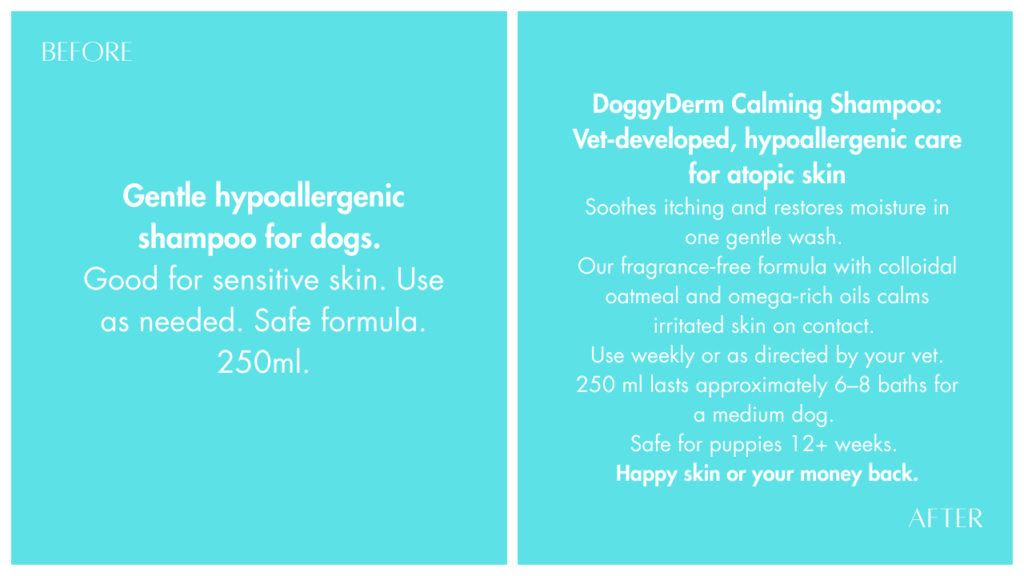
Before (lousy):
Gentle hypoallergenic shampoo for dogs. Good for sensitive skin. Use as needed. Safe formula. 250ml.
After (awesome):
DoggyDerm Calming Shampoo: Vet‑developed, hypoallergenic care for atopic skin
Soothes itching and restores moisture in one gentle wash. Our fragrance‑free formula with colloidal oatmeal and omega‑rich oils calms irritated skin on contact. Use weekly or as directed by your vet. 250 ml lasts approximately 6–8 baths for a medium dog. Safe for puppies 12+ weeks. Happy skin or your money back.
You can see why the revised product copy is better, right?
One’s basic; the other has a clear benefit headline, vet credibility, key ingredients, time frame (“within hours”), usage and yield, safety, and guarantee—all good for conversion.

4. Create awesome content
From videos to blog posts, great content enhances your brand’s online presence.
But that’s not all!
A variety of content lands your brand in front of a wider audience, people who may not otherwise find you. It encourages engagement; nurtures relationships; and helps you build a loyal following.
The key, though, is to focus on creating quality content that remains on-brand.
Start here: examples of high‑impact content for pet brands
Here’s what to create and why.
✅ Training how-tos
Short videos or step-by-step posts that solve common pet parenting problems including crate and potty training.
These build trust and position your brand as helpful.
✅ Ingredient explainers
Plain-English posts, infographics, or short clips that explain ingredients (e.g. “What is colloidal oatmeal?”) and why they matter for pets.
These reduce purchase anxiety for conscious consumers.
✅ Daily routines or “a day in the life” content
Short videos showing products or your services used in real life (meals, grooming, play, safety, cleaning, etc.)
These are used for high engagement and easy to repurpose as ads.
✅ Customer stories
Spotlight rescues or customer journeys with before/after photos and quotes. Great for emotional resonance that drives shares and perfect for social proof.
✅ Vet Q&A/expert interviews
Create 5-10 minute videos or transcribed posts answering common questions or concerns.
These types of content build your authority and can be reused in many other formats including in your email marketing.
✅ Quick tips & micro-content
Make 15-30 second clips for social media with one actionable tip.
These are perfect for growing your reach and building followers.
✅ Product use guides
Practical guides that are particularly useful to your audience and that explain your product in greater detail. Reduces returns and supports customer satisfaction.
✅ Comparison and “which to choose” guides
Write “this versus that” blog posts that help buyers pick the right product according to specific criteria.
This type of pet marketing content increases conversion by reducing choice paralysis and simplifying the decision-making process.
✅ Seasonal/event content
Develop must-read holiday gift guides, safety tips, or must-dos for pet owners.
They’re useful for timely promotions and can be used to boost sales.
What to do next: an easy way to get started creating pet marketing content for your small business
Start with two formats you can produce consistently (e.g. one short video + one blog post per week), then repurpose content across social, email, and landing pages to maximize reach and ROI.
5. Hang out on social media
Social’s not enough but you sure as heck still need it!
Because: Content = assets and social media = distribution + community
People have short attention spans—they love easy-to-consume visual content like pretty pics and fun videos. But people also love personal connection and interactions, which is what social media offers. So, take your social media strategy and marketing seriously.
6. Send emails
Building an email list must be part of your pet marketing from day one. Email marketing is low-cost and ultra-flexible. Use marketing emails to:
- advertise existing as well as new products;
- excite subscribers with promotional deals and special offers;
- highlight product benefits and proper use;
- and educate readers on pet-related topics of interest.
In other words, your emails can inspire and prompt recipients to take action.
Start here: email funnel recommendations
These are simple, high-impact sequence suggestions I can help you develop.
✅ Create a hard-to-resist lead magnet
Capture emails with a low-friction offer (e.g. “Free 5-day training plan,” “Top 10 anti-inflammatory foods to add to your dog’s diet,” “10% off your first order”). Keep it relevant to the product category so signups are quality leads.
✅ Write a strategic welcome sequence
If your goal is to move new leads to first purchase, your email sequence might be something like three messages sent out over 7-10 days.
- Email #1 delivers the lead magnet + brand story.
- Email #2 highlights product benefits and social proof.
- Email #3 is a first-order incentive with a clear call to action.
(The exact sequence contents depend on your goals and product/service type. Book your FREE 20-minute discovery call for help planning and writing your email sequences.)
✅Set up a cart abandonment sequence
You’d send these at a certain time (maybe within 24 hours) reminding the shopper about their would-be purchase and offer an easy checkout link. You’d add a few other compelling reasons to complete the purchase. That could be reviews, star ratings, or a special offer.
✅ Suggest a subscription/lifecyle offer
If you sell consumables, follow post-purchase with a one-click subscription upsell (e.g. “Save 20% when you auto-renew”) and a re-order reminder before the expected run-out date.
✅ Develop an educational drip
Here, you send out curated emails around a specific topic to encourage purchases, reduce returns, or increase product usage satisfaction.
These sequences turn casual visitors into customers and customers into predictable repeat buyers with very little ongoing cost.
Bonus: make your packaging stand out
This one isn’t related to your online presence, but it’s just as important: don’t skimp on packaging design and the corresponding copy.
If you want to increase sales of your pet products, then your product must first grab shoppers’ attention. And that’s not easy to do on a crowded shelf of competing products.
So eye-catching is the first part; convincing is the second part of the equation. (Price considerations excluded.)
Small budgets don’t have to hold your pet marketing back!
Focus on the few digital levers that reliably generate revenue for your pet brand: a conversion‑ready website, clear product and packaging copy, simple subscription mechanics for consumables, and two tight paid‑ad + landing‑page tests supported by content and email follow‑ups.
Do those well and you’ll turn casual browsers into paying customers and one‑time buyers into predictable repeat revenue.
If you’d like help making it happen, I write strategic content and conversion copy for pet brands: websites, product pages, landing pages, email sequences, and ad copy. Book YOUR free 20‑minute discovery call today.